FirstFlow
Cash has arrived — but what does it belong to?
Intelligent cash reconciliation for syndicated loans and private credit
An incoming wire confirms that money has moved. It does not always explain which loan, lender position or servicing event the money belongs to. For banks and private-credit managers, closing that gap is the real reconciliation challenge.
FirstFlow, from FirstSignals, is designed around that decision: assemble the evidence, identify plausible matches and use confidence to determine which items can proceed automatically and which need an operations specialist.
Why the wire is only part of the story
Agent notices, payment references, expected cash flows and loan positions answer different questions. A notice explains an event; a wire records a receipt; the servicing system records what the institution expected. Those records must agree before the receipt can be confidently attributed.
S&P Global’s DataXchange supports notices delivered through email and fax, illustrating the mix of channels still surrounding loan servicing. Its reconciliation research also describes non-standard cash files and complex issuer-name and security-identifier matching. [3][4]
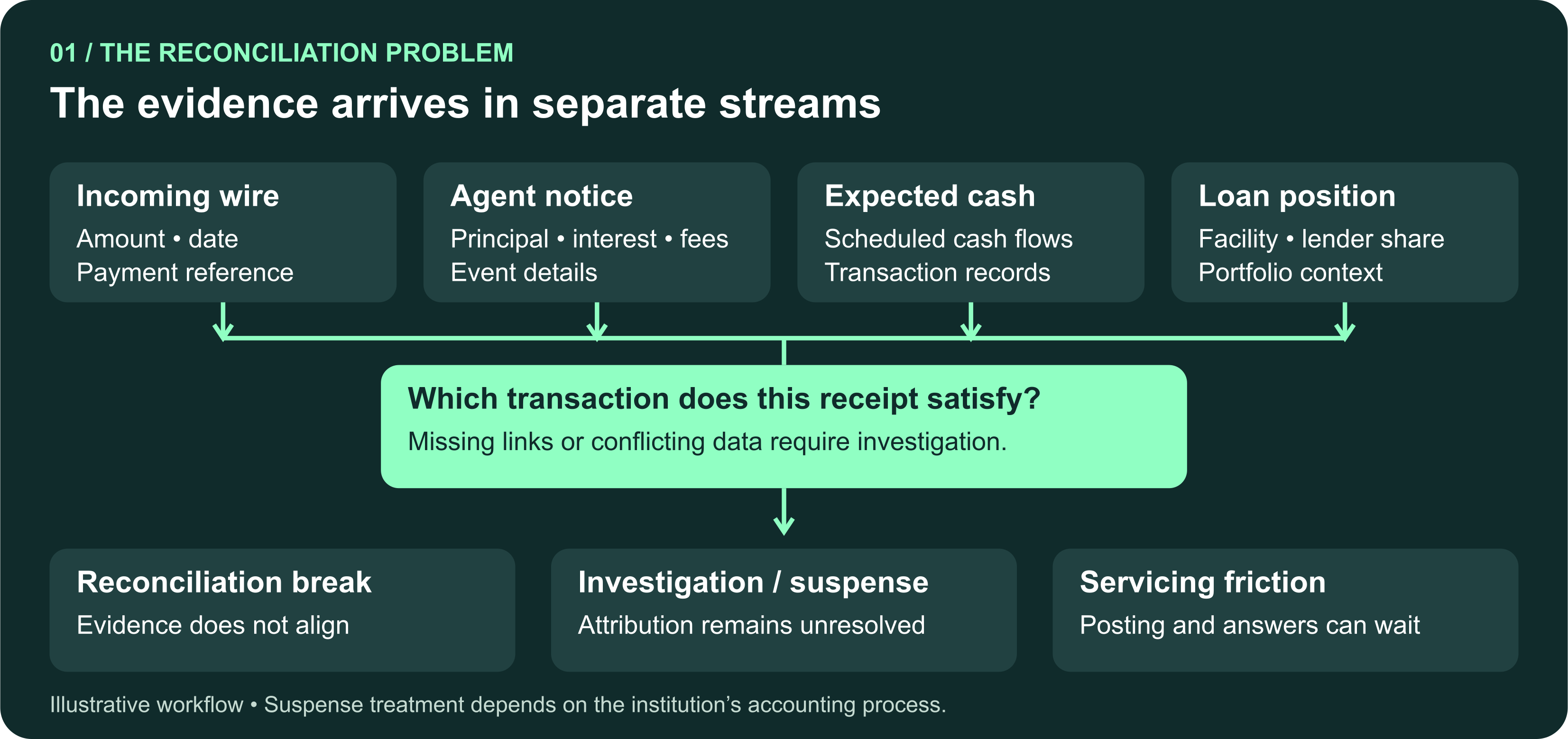
Figure 1. Why cash attribution stalls. Separate records must be connected before a receipt can be applied with confidence. Illustrative synthesis; see sources 3 and 4.
Published evidence of the automation gap
McKinsey’s January 2024 analysis reports that most banks’ reconciliation straight-through-processing rates often fall below 50%. A select group of leading institutions achieves 80–90%, using workflow tools and machine learning alongside core loan-processing platforms. [1]
<50% Reconciliation STP often seen at most banks [1]
80–90% Reconciliation STP at select leading institutions [1]
24M+ Agent notices digitized annually by S&P Global [2]
These are observations about reconciliation in the bank operating models discussed by McKinsey, not a measured average for every bank or private-credit manager. Nor are they FirstFlow results. They show the distance between heavily manual workflows and more automated operating models.
The information burden is substantial. In July 2025, S&P Global reported digitizing more than 24 million agent notices annually on behalf of clients. That is a provider-specific document volume, not an industry-wide payment count: a notice should not be treated as a wire or a unique cash receipt. [2]
When a matching problem becomes client friction
Consider an illustrative receipt covering interest and a fee. If the wire provides only an abbreviated reference while the notice arrives separately, an analyst must first establish the relevant facility and then determine how to allocate the total. A superficially similar amount on another loan can make an amount-only match unsafe.
Until the evidence is sufficient, the receipt may remain unapplied or in suspense, depending on the institution’s accounting process. A reconciliation break is a discrepancy requiring resolution; it is not automatically evidence of missing cash or a loss.
For the operations team, the consequence can be repeated searches, agent follow-ups and delayed posting. For the client-facing team, it can mean being unable to confirm promptly how a receipt was applied. McKinsey identifies unreconciled backlogs and connects loan-operations modernization with a better borrower experience. [1]
FirstFlow connects the evidence to the decision
FirstFlow’s confidence-based approach brings expected transactions, incoming payments, agent information and historical matching patterns into a common decision process. The goal is to automate well-supported matches while keeping ambiguous cases visible to the people responsible for resolving them.
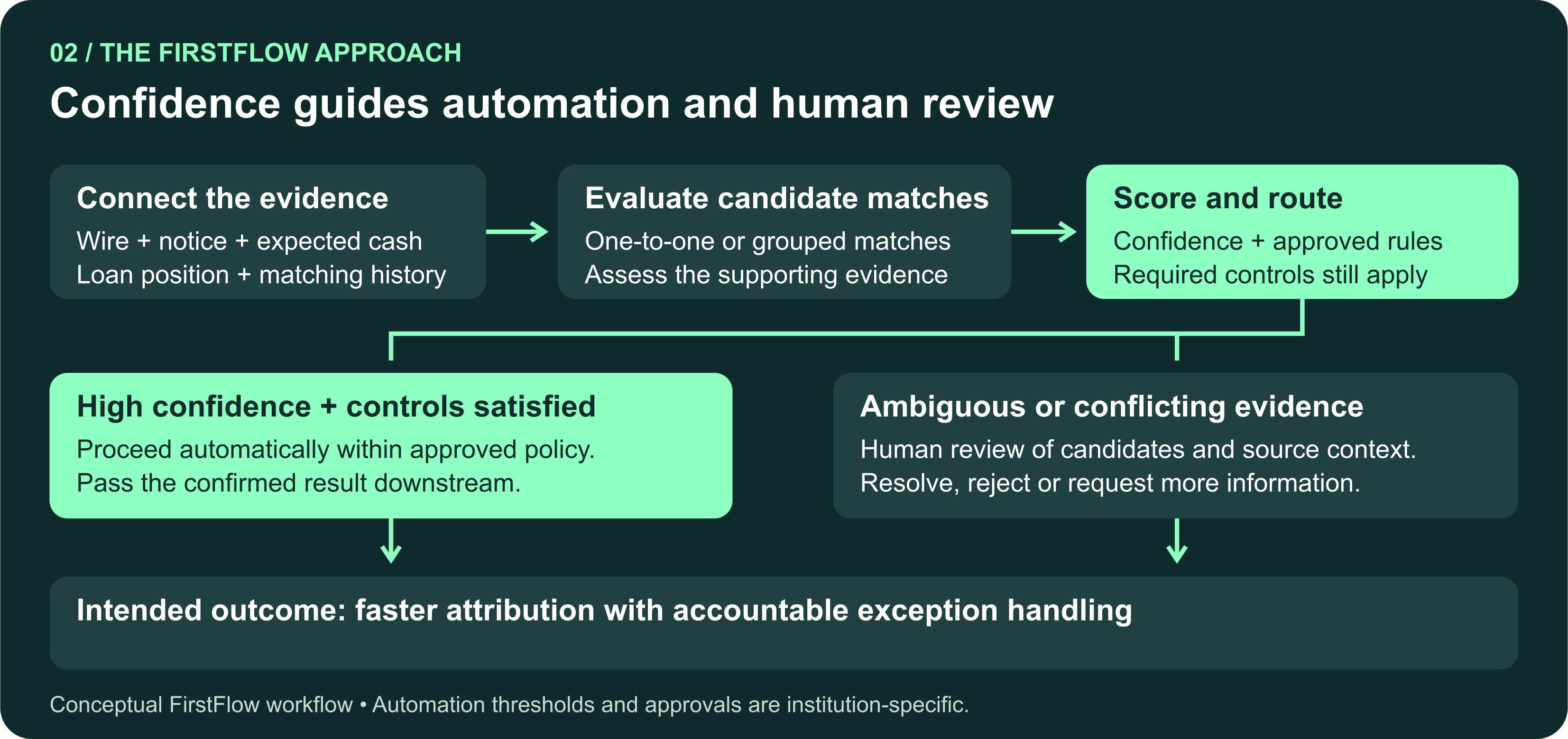
Figure 2. FirstFlow’s confidence-based approach. High-confidence matches proceed within approved controls; ambiguous cases receive human review. Conceptual workflow, not a performance claim.
Connect the context. Bring together the receipt, notice and expected transaction, with the relevant loan position. Differences in references or formatting should become information to evaluate, rather than a reason to lose the connection between records.
Evaluate candidate matches. Assess which transaction, or combination of transactions, best explains the cash. S&P Global describes many-to-one and many-to-many matching as a challenge that AI can help address in private credit. This supports the approach; it is not an endorsement of FirstFlow. [4]
Route by confidence. High-confidence candidates can proceed within the institution’s approved rules. Ambiguous or conflicting evidence goes to an operations specialist with the candidate matches and supporting context. Confidence alone should not override required approvals or posting controls.
Keep people accountable. Human review is part of the operating model. Analysts must be able to reject a suggestion, request missing information and resolve the exception before an approved result moves downstream.
Measure success beyond the auto-match rate
The practical objective is to reduce unresolved work without weakening control. Start with a defined portfolio and a clear baseline. Track the share of receipts reconciled without manual intervention alongside incorrect matches, reversals, exception age and time to final posting. Keep the denominator consistent so that improved results are not simply a change in which transactions are counted.
Measure the experience of the people doing the work, too: how often they must chase a notice, how long they spend investigating a break and how quickly client-facing teams can answer a cash-allocation question. These measures make the business case specific to the institution rather than dependent on a generic savings promise.
FirstFlow’s value proposition is straightforward: connect fragmented evidence, support better matching decisions and focus skilled operations capacity on the cases that need judgment. The payoff to test is faster, more dependable cash attribution—from the moment a wire arrives to the moment its purpose is understood.
Bring your reconciliation workflow to FirstSignals
Explore where FirstFlow’s confidence-based matching can reduce investigation effort and improve the handling of exceptions.
About the Author
Karishma Daga works at the intersection of credit, financial technology and Artificial Intelligence, with a focus on using data and AI to modernize how financial institutions monitor and manage credit risk.
Email: karishma@firstsignals.io
Sources
McKinsey & Company. Modernizing syndicated-loan operations. January 25, 2024.
S&P Global Market Intelligence. AI in Private Credit: Surfacing Deeper Data Insights. July 24, 2025.
S&P Global Market Intelligence. DataXchange. Product page.
S&P Global Market Intelligence. AI in private credit: Strengthening the reconciliation function. August 6, 2025.
Published figures describe the sources’ stated populations and periods. They are not FirstFlow performance claims or guarantees.