Private Credit
AI-Powered Early Warning Intelligence: The Next Imperative for Private Credit
Why the next generation of portfolio monitoring must move from periodic thresholds to continuous, contextual risk intelligence.
Private credit has spent much of the last decade perfecting the art of origination. The next decade may be defined by something different: the ability to identify deterioration early enough to act.
That capability is becoming increasingly important as private credit portfolios grow in size and complexity. Managers are overseeing more borrowers, more industries and more nuanced capital structures, while operating performance is becoming increasingly differentiated across sectors and individual credits.
Recent market evidence reinforces the point. KBRA has reported that selective credit issues became more prevalent across its rated BDC universe during the first half of 2026, contributing to another sequential increase in non-accrual investments. Alvarez & Marsal has similarly highlighted increasing dispersion in credit performance, a growing share of debt positions marked at distressed levels, and emerging refinancing risks in parts of the market.1,2
For private credit managers, this changes the monitoring question.
“Has this borrower breached?” is increasingly less valuable than: “What has changed — and does the combination of those changes tell us that this borrower is moving toward stress?”
That is fundamentally an Early Warning Indicator — or EWI — problem.
Traditional monitoring has a latency problem
Most private credit firms already monitor portfolio risk extensively. The challenge is not the absence of monitoring. It is the latency and fragmentation of the monitoring model.
Important credit signals can sit across financial statements, compliance certificates, covenant calculations, borrowing-base reports, credit agreements and amendments, portfolio-company reporting, management communications, industry data, and external economic and market information.
Individually, many changes may appear relatively benign. EBITDA declines modestly. Covenant headroom falls. Receivable days increase. A covenant definition is amended. Part of the interest burden moves from cash to PIK. Management revises its forecast. Industry conditions soften.
None of these developments necessarily represents a default. Together, however, they may represent a very different credit story.
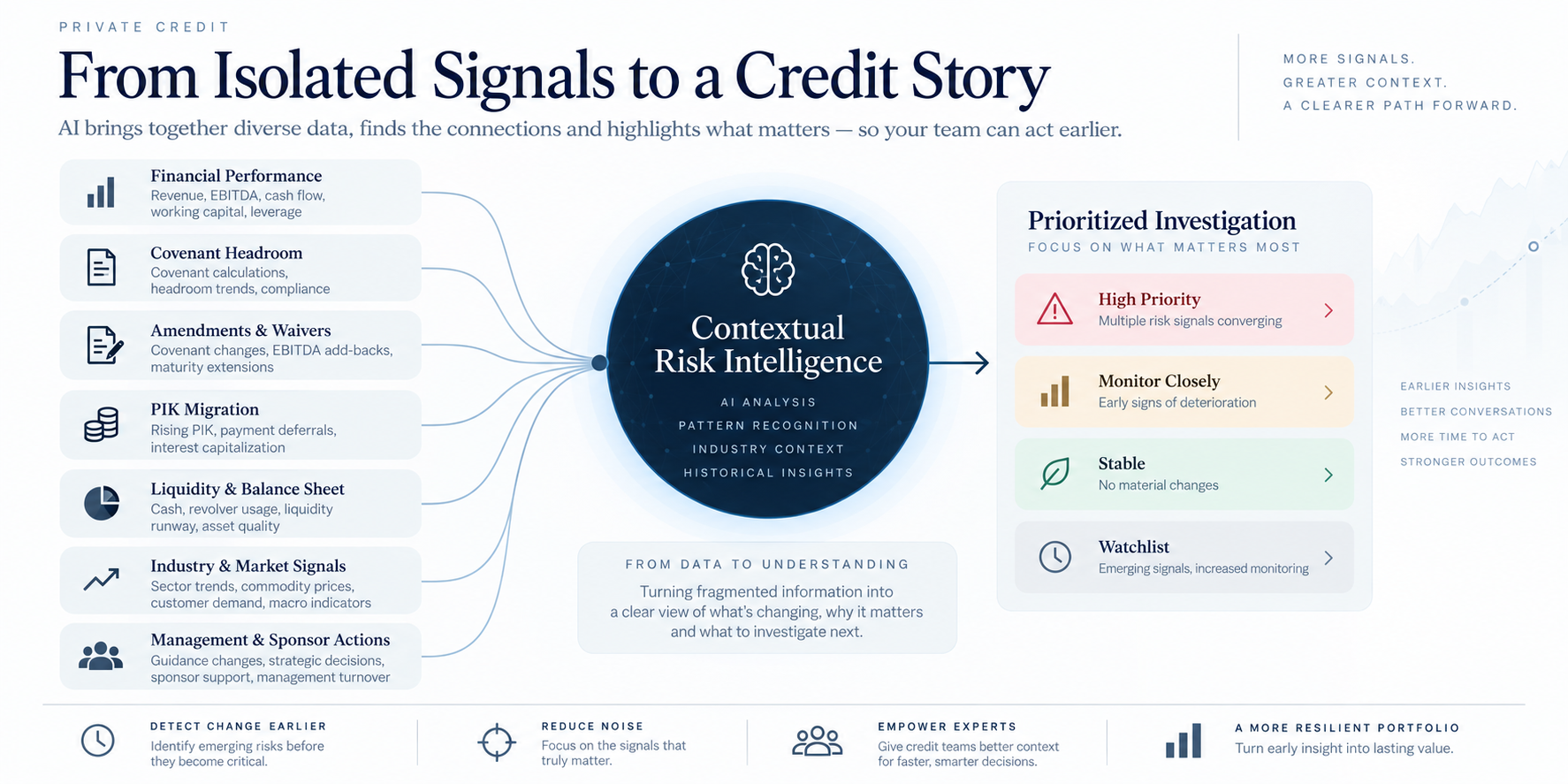
Figure 1. AI-based EWI connects fragmented borrower, covenant, liquidity, market and management signals into contextual risk intelligence.
The distinction is critical: the objective is not simply to collect more signals. It is to understand how those signals interact.
EWI needs to evolve from thresholds to intelligence
Historically, many Early Warning Indicator frameworks have been built around thresholds: leverage exceeds X; liquidity falls below Y; EBITDA declines by Z%; a covenant is breached.
These rules remain valuable. They are deterministic, explainable and easy to audit. But they primarily answer: Has something happened?
The next generation of EWI needs to answer a more sophisticated set of questions:
- What is changing?
- Why is it changing?
- Are multiple indicators deteriorating simultaneously?
- How unusual is this pattern for this borrower or industry?
- What should the portfolio manager investigate?
Consider two borrowers whose leverage increases from 4.5x to 5.0x. For the first borrower, the increase might result from a temporary working-capital investment ahead of contracted growth. For the second, EBITDA may be declining, accounts receivable deteriorating, covenant headroom compressing and an increasing portion of interest being capitalized through PIK.
The leverage ratio is identical. The credit risk is not.
This is why the future of EWI is about context, convergence and trajectory — not simply thresholds.
AI changes the economics of portfolio monitoring
Traditional credit monitoring depends heavily on people manually gathering information, interpreting documents, calculating ratios, reviewing covenant compliance and connecting information from multiple systems. That approach works — but it becomes increasingly difficult to scale as portfolios expand.
AI provides an opportunity to combine structured financial information with the enormous amount of unstructured information surrounding a credit.
An AI-enabled monitoring platform can continuously analyze structured data such as financial statements, leverage, liquidity, interest coverage, borrowing-base information, covenant calculations and collateral metrics — alongside unstructured information such as credit agreements, compliance certificates, amendments, management commentary, portfolio-company updates, industry research and relevant external information.
The real value emerges when these sources are evaluated together rather than independently.
Signal convergence is where EWI becomes powerful
Imagine a monitoring system identifies that EBITDA has declined for three consecutive quarters, interest coverage has weakened, covenant headroom has compressed, the latest amendment provides additional EBITDA add-backs, part of cash interest has migrated to PIK, receivable days are increasing, and industry indicators have weakened.
No individual signal necessarily means that the borrower is distressed. But their convergence should demand attention.
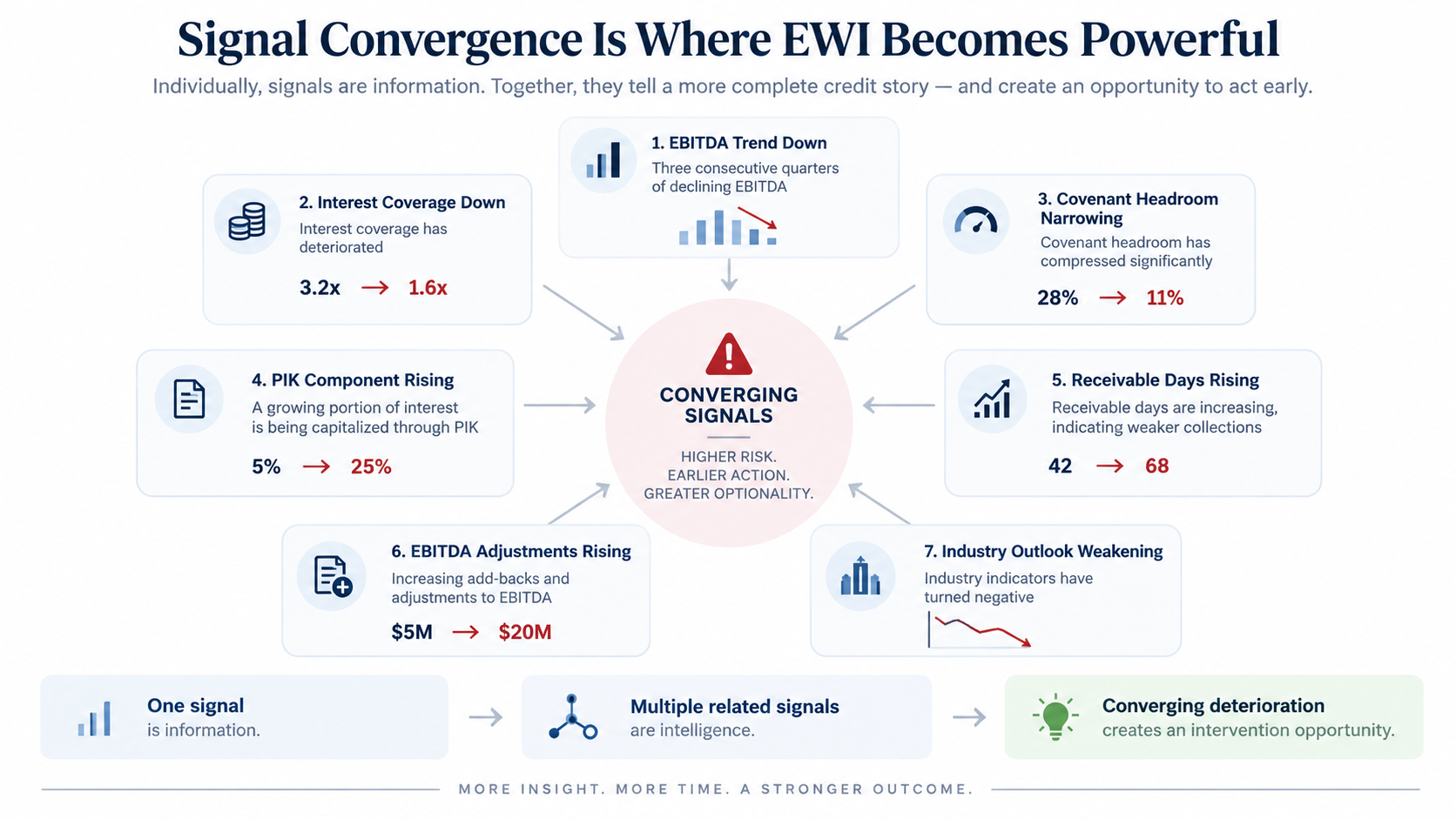
Figure 2. One signal is information; multiple related signals create intelligence; converging deterioration creates an intervention opportunity.
This is the fundamental opportunity for AI-powered EWI: moving from isolated alerts toward contextual risk intelligence.
Private credit should monitor hidden stress, not just default
This becomes particularly important because default statistics do not necessarily tell the complete story of portfolio health.
Private credit lenders and sponsors have multiple mechanisms available to address underperforming credits before a conventional payment default occurs. These can include covenant amendments, waivers, maturity extensions, EBITDA adjustments, interest capitalization, PIK structures, sponsor equity contributions and broader liability-management actions.
Many of these interventions are entirely rational ways to preserve enterprise value and provide borrowers with time to recover. But they create an important monitoring question:
Is underlying credit quality improving — or is the capital structure being modified to accommodate continued deterioration?
A sophisticated EWI framework should therefore monitor not only the borrower’s financial performance, but also the evolution of the credit itself.
Repeated amendments without operating improvement may be relevant. Increasing PIK alongside declining free cash flow may be relevant. Expanding EBITDA adjustments alongside shrinking covenant headroom may be relevant. Extending maturity without addressing fundamental operating weakness may be relevant.
The important word is may. None of these signals should automatically generate a negative credit conclusion. The value of AI is its ability to identify patterns that deserve human investigation.
Every industry requires a different EWI framework
Credit deterioration does not look the same across industries.
SaaS: customer retention, ARR growth and churn may be more predictive than inventory.
Healthcare: reimbursement trends, labor costs and payer mix can become critical.
Manufacturing: order backlog, commodity inputs and capacity utilization may provide earlier signals.
Commercial real estate: occupancy, lease expirations, rents and refinancing requirements may dominate the risk profile.
Recent private-credit market analysis illustrates this growing differentiation. A&M notes that lenders are increasingly distinguishing between mission-critical software and more discretionary software businesses that may face greater AI-related disruption.2
The implication is significant. The future of EWI cannot simply be a universal list of ten financial ratios applied identically across every borrower.
It requires an institutional knowledge layer capable of understanding which indicators matter for a particular Borrower × Industry × Capital Structure × Covenant Package × Economic Environment.
AI makes that depth of monitoring increasingly achievable at portfolio scale.
From periodic reviews to continuous monitoring
Private credit monitoring has traditionally been calendar-driven: monthly reporting, quarterly financials, annual reviews and compliance certificates. But risk does not operate on a quarterly schedule.
A meaningful industry event can occur tomorrow. Commodity prices can move rapidly. A major customer can fail. Management can request an amendment. Liquidity can deteriorate between reporting periods.
AI makes it increasingly practical to move from periodic monitoring toward continuous exception-based monitoring.
Instead of asking portfolio teams to examine every borrower with equal intensity, technology can continuously monitor the portfolio and direct human attention toward credits where the combination of signals has materially changed.
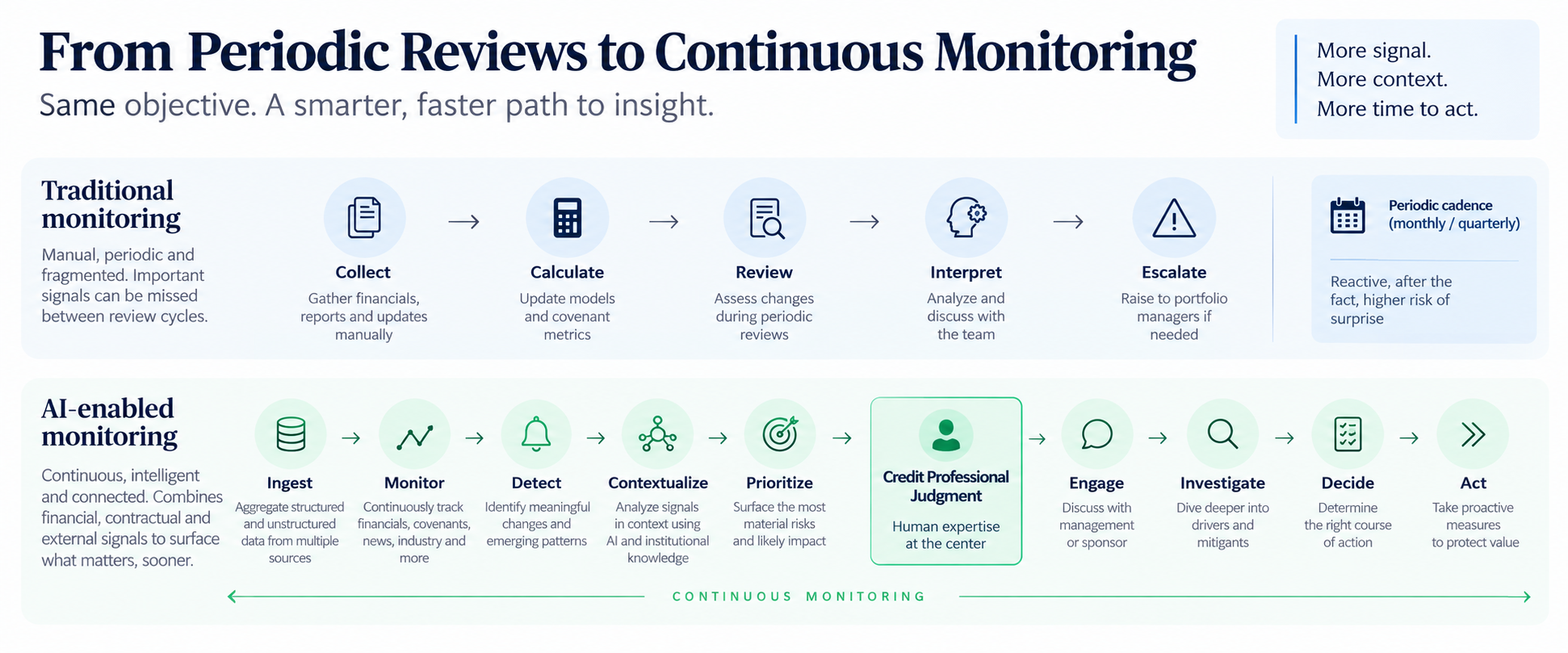
Figure 3. AI changes the monitoring operating model from periodic, manual review to continuous exception-based surveillance with credit-professional judgment at the center.
The objective is not to replace the portfolio manager. It is to make the portfolio manager’s scarce judgment more valuable.
The objective should not be more alerts
More alerts do not equal better risk management. A system generating hundreds of warnings can simply create another inbox that portfolio teams eventually learn to ignore.
The objective of AI-powered EWI should therefore be prioritization rather than notification.
1. What changed? Identify the underlying event, metric or trend.
2. Why does it matter? Explain its relevance within the borrower’s credit context.
3. What else changed? Connect the signal with related financial, covenant, industry and behavioral indicators.
4. What requires investigation? Prioritize the issue for a credit professional without attempting to replace their judgment.
This distinction is important. An effective credit platform should combine deterministic credit rules with AI-based interpretation. Covenant calculations should remain traceable. Financial data should retain lineage to its source. AI-generated conclusions should identify supporting evidence. Human credit professionals should remain accountable for credit decisions.
For financial institutions, explainability is not an optional feature of AI-powered credit monitoring. It is part of the architecture.
The bigger opportunity: institutional credit intelligence
There may be an even larger strategic opportunity. Every credit cycle generates institutional knowledge.
Which signals preceded deterioration? Which covenant changes proved meaningful? Which industry indicators provided the earliest warning? Which management behaviors preceded liquidity problems? Which interventions worked? Which apparently concerning signals ultimately proved irrelevant?
Historically, much of this knowledge has resided with individual portfolio managers and credit officers. AI creates the possibility of capturing those experiences systematically.
Signals → Deterioration → Intervention → Outcome
That creates a powerful feedback loop. Better monitoring informs better underwriting. Better underwriting identifies better monitoring signals. And portfolio outcomes continuously improve the firm’s understanding of credit risk.
The result is something more valuable than another risk dashboard. It is institutional credit intelligence.
The real value of EWI is time
Ultimately, Early Warning Indicators are not about predicting every default. Credit is inherently uncertain, and no technology will eliminate that uncertainty.
Buy time.
Time to engage management. Time to understand a liquidity problem. Time to request additional reporting. Time to reassess collateral. Time to renegotiate a covenant. Time to involve the sponsor. Time to protect downside. And sometimes, time to determine that an apparent warning signal requires no intervention at all.
For a private credit manager, that time has economic value.
As portfolios expand and credit structures become increasingly complex, differentiated portfolio performance may depend not only on originating attractive credits.
It may increasingly depend on identifying when the credit story begins to change — while there is still time to do something about it.
That is why AI-powered Early Warning Intelligence is evolving from an interesting technology capability into a core component of the modern private-credit operating model.
About the Author
Karishma Daga works at the intersection of credit, financial technology and Artificial Intelligence, with a focus on using data and AI to modernize how financial institutions monitor and manage credit risk.
Email: karishma@firstsignals.io
Selected Sources
- KBRA, as summarized by ABL Advisor, “BDC Valuation Pressures Ease in 2Q26 as Selective Credit Stress Emerges,” September 4, 2026. Source
- Alvarez & Marsal, “September 2026 Debt Market Update,” September 16, 2026. Source